


Sunday, 11/10/2026 | 12:34
Project activities
Consultation on the methodology for developing and updating energy consumption standards for four major industrial sectors
10:57 - 10/12/2025

On the morning of December 9, in Hanoi, a technical consultation meeting on the methodology for reviewing, updating, and developing new energy efficiency benchmarking for industrial sectors was organized.
On the morning of December 9, in Hanoi, Innovation, Green Transition, and Industry Promotion (Ministry of Industry and Trade) organized a technical consultation meeting on the methodology for reviewing, updating, and developing new energy efficiency benchmarking for the NPK fertilizer production, seafood processing, yarn production, and textile sectors.. The event was held within the framework of the Vietnam Scaling Up Energy Efficiency Project (VSUEE), attracting participation from regulatory agencies, experts, consulting units, and enterprises.
In his opening remarks, Mr. Hoang Viet Dung, Deputy Head of the Energy Efficiency and Green Transition Department, Innovation, Green Transistion and Industry Promotion (IGIP - Ministry of Industry and Trade), stated that to date, the Ministry of Industry and Trade (MOIT) has issued seven Circulars stipulating energy consumption norms for energy-intensive industries such as steel, paper, plastics, beverages, sugar, chemicals, and seafood processing. The Ministry is also reviewing and updating several sectors, including NPK fertilizer production and seafood processing, while developing new norms for two highly energy-consuming industries: yarn production and textile dyeing.
However, practical implementation shows that reporting and verifying compliance with the norms still face many difficulties, partly due to challenges in data collection and calculation, and partly due to enterprises’ awareness and fulfilment of responsibilities. Therefore, Mr. Dung requested participants to provide direct and constructive feedback to ensure that the issued norms are feasible and effectively applicable in practice.

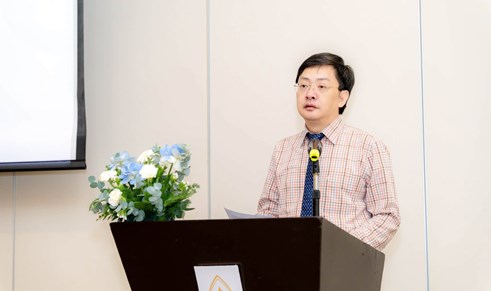
Mr. Hoang Viet Dung, Deputy Head of the Energy Efficiency and Green Transition Department (IGIP - MOIT), delivers the opening remarks.
Presentation of methodologies for reviewing and updating norms in four subsectors
At the meeting, Mr. Trinh Khanh Hoa, representative of EPRO Consulting JSC, presented the methodology for reviewing and updating energy consumption norms for the seafood processing industry. According to the report, in current seafood processing plants, refrigeration systems account for approximately 80–85% of total electricity consumption, while activities such as office operations, water treatment, and preliminary processing account for only 15–20%. During the research phase, the team reviewed 300 processing facilities, including 126 fish-processing and 153 shrimp-processing establishments, and also conducted 10 preliminary energy audits at fish and shrimp processing plants to update actual energy use and identify saving potentials.
For the NPK fertilizer production industry, the report presented by Mr. Ma Khai Hien, Director of the Energy Conservation Research and Development Center (ENERTEAM), showed that the current energy consumption standard is still based on Circular 02/2014/TT-BCT, while production technologies have undergone significant changes. The sector currently has more than 200 fertilizer producers, including 22 NPK plants classified as key energy users. Many production lines commissioned between 2018–2024 feature high levels of automation and significantly lower energy consumption compared to older lines. Therefore, developing new norms for different technologies, such as tower, rotary drum, pan granulation, press granulation, and blending, is considered essential.

Mr. Ma Khai Hien, Director of ENERTEAM, presents the methodology for reviewing energy consumption norms in the NPK fertilizer and fabric production industries.
In the presentation on the yarn production industry, Ms. Tang Thi Hong Loan, Director of EPRO Consulting JSC, reported that Vietnam currently has 324 yarn-producing facilities, including 101 classified as key energy users. In 2023, total production reached approximately 2 million tons of short-staple fibers, 1.68 million tons of filament yarn, and 0.88 million tons of thread. The development of the energy consumption standard will focus on two main product groups, which are short-staple fiber and filament, based on spinning technology characteristics and electricity consumption levels for each product type.
Concluding the series of presentations, the report on the textile industry was also delivered by Mr. Ma Khai Hien. According to the report, this sector is highly energy-intensive and high-emitting, with total energy costs of approximately USD 3 billion annually and an estimated 5 million tons of CO₂ emissions per year. Vietnam currently does not have a dedicated energy consumption standard for the textile industry. Due to the wide variety of technologies and large variations in energy intensity across dyeing and finishing processes, the development of a benchmark system by individual processing stages and fabric types is identified as an essential foundation for future national norms.
Policy improvement contributions
During the discussion session, Mr. Cu Huy Quang, Head of the Energy Efficiency and Green Transition Department (IGIP - MOIT), noted that for the seafood processing and NPK fertilizer sectors, calculations and methodologies must be further reviewed to accurately reflect actual conditions, given enterprises’ increasingly diverse use of energy sources such as grid electricity, solar power, and thermal energy.
For the sectors where new standards are being developed, including yarn production and textile, he emphasised the importance of clearly disaggregating energy consumption by processing stage, defining accurate measurement boundaries, and specifying units for Specific Energy Consumption (SEC) from the outset to avoid overlap during application. Representatives of enterprises and associations expressed their expectations that the new norms will be more aligned with actual production conditions, and they recommended strengthening advisory services, technical assistance, and dissemination of regulations so that enterprises, particularly small and medium-sized ones, can gradually meet requirements on energy efficiency.

Mr. Cu Huy Quang, Head of the Energy Efficiency and Green Transition Department (IGIP - MOIT), shares his opinion during the meeting.
Concluding the meeting, Mr. Hoang Viet Dung noted that all recommendations will be consolidated, reviewed, and used to refine the methodology for developing energy consumption norms for the four industries. This will serve as the basis for finalising the technical dossier and submitting it to competent authorities for promulgation in the near future, thereby contributing to promoting energy efficiency and emissions reduction in enterprises.
Photos from the meeting:

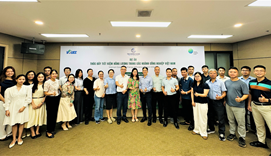
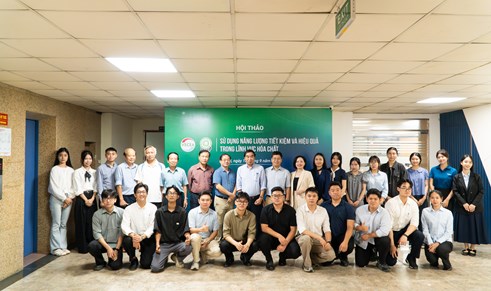
Delegates participate in the consultation meeting.

Mr. Trinh Khanh Hoa, representative of EPRO Consulting JSC, is presenting the report on the seafood processing industry.

Ms. Tang Thi Hong Loan, Director of EPRO Consulting JSC, is presenting the methodology for the yarn production industry.


Representatives from associations and enterprises providing feedback.
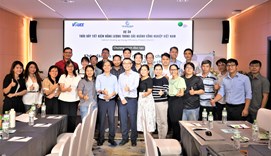
VSUEE Project Management Board.


More
-
 Industrial Enterprises Improve Energy Efficiency through ISO 50001:2018
14:40 - 13/08/2026
-
-
![[PODCAST] No.6: Support Technical Guidance Development in Industrial Sectors](https://media.vsuee.vn/Images/User/ducdt/2025/12/mr_thanh_ta.png?w=271&h=156&mode=crop) [PODCAST] No.6: Support Technical Guidance Development in Industrial Sectors
[PODCAST] No.6: Support Technical Guidance Development in Industrial Sectors16:32 - 14/12/2025
-
![[PODCAST] No.5: Energy efficiency and conservation technology in Vietnam's Industrial sectors](https://media.vsuee.vn/Images/User/ducdt/2025/12/mr_quang_ta.png?w=271&h=156&mode=crop)
-

-
![[PODCAST] No.4: Applying the ESCO model to promote energy efficiency and conservation](https://media.vsuee.vn/Images/User/ducdt/2025/12/mr_nguyen_ta.png?w=271&h=156&mode=crop)
LATEST NEWS
EVENTS
-
 27/10/2025
WEBINAR 3 - ESCO Model, A key to promote energy efficiency and conservation
-
06/10/2025
WEBINAR 2 - Financial Support Industrial Enterprises in Energy Efficiency - Opportunities and Challenges
-
22/09/2025
WEBINAR 1 - Scaling Up Energy Efficiency in Vietnam


